Imagine a company with a robust financial future, one that can withstand market fluctuations and seize investment opportunities with confidence. Levered free cash flow is the key to unlocking such a future, but what exactly is it, and how can it be leveraged to inform corporate decision-making?
At its core, levered free cash flow is a measure of a company’s cash flow that takes into account its debt obligations and interest expenses. This nuanced metric goes beyond traditional free cash flow metrics by acknowledging the significant impact that debt can have on a company’s financial health.
Definition of Levered Free Cash Flow that Captures the Dynamics of Debt Obligations and Interest Expenses in Financial Planning Strategies

Levered free cash flow is a critical concept in corporate finance that assesses a company’s ability to generate cash from its operations while considering the impact of debt obligations and interest expenses. This concept is essential in evaluating the liquidity and solvency of a company, as it provides a clear picture of its cash-generating capacity.
Levered free cash flow is a key profitability metric that measures a company’s ability to reinvest and distribute earnings after accounting for capital expenditure. When evaluating a company’s growth potential, it’s also essential to consider healthier fast food options like gluten free fast food options to fuel the minds behind innovative business ideas, ultimately fueling growth and increasing a company’s ability to generate significant levered free cash flow.
Importance of Accounting for Debt Obligations and Interest Expenses
When determining a company’s free cash flow, it’s crucial to consider the debt obligations and interest expenses that impact its cash flow. This is because debt obligations and interest expenses can significantly affect a company’s ability to generate cash and invest in growth opportunities.
- Cash flow from operations
- Change in working capital
- Capital expenditures
These factors are essential in understanding the dynamics of debt obligations and interest expenses on a company’s cash flow.
Determining a company’s free cash flow without considering debt obligations and interest expenses can lead to an incomplete or misleading picture of its financial health.
Impact of Debt Obligations on Free Cash Flow
Debt obligations can have both positive and negative impacts on a company’s free cash flow. A company with a manageable level of debt can utilize borrowed funds to invest in growth opportunities and generate additional cash flow through increased revenues.
- Interest expenses
- Principal repayments
- Debt service requirements
On the other hand, excessive debt can lead to increased debt service requirements, higher interest expenses, and reduced investment opportunities, ultimately harming the company’s financial health.
Companies with high debt levels may experience reduced investment opportunities and increased debt service requirements, ultimately impacting their cash flow and financial health.
Calculating Levered Free Cash Flow
Levered free cash flow can be calculated by adjusting a company’s free cash flow for the costs associated with servicing its debt, including interest expenses and principal repayments.
- Earnings before interest and taxes (EBIT)
- Interest expenses
- Principal repayments
- Debt service requirements
By considering these factors, levered free cash flow provides a comprehensive view of a company’s cash-generating capacity and ability to invest in growth opportunities while managing its debt obligations.
Levered free cash flow is a powerful metric used to evaluate a company’s profitability, but it’s essential to consider government incentives, like the free tablet government initiative, that can boost consumer spending and drive demand for businesses, ultimately increasing their free cash flow and providing a clearer picture of their financial performance.
Conclusion
In conclusion, understanding the dynamics of debt obligations and interest expenses is critical in evaluating a company’s free cash flow and liquidity. By considering these factors, investors and analysts can gain valuable insights into a company’s financial health and make informed decisions about investments, financing, and strategic initiatives.
Measuring Levered Free Cash Flow with a Focus on the Impact of Capital Structure on Cash Flow Generation
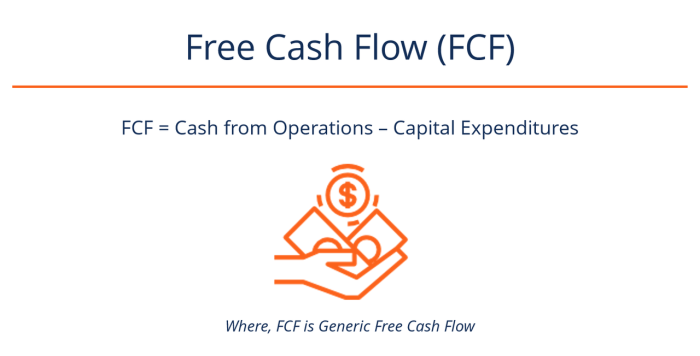
Levered free cash flow (LFCF) is a critical metric in financial planning and analysis, as it helps investors and analysts understand a company’s ability to generate cash after accounting for its capital structure. The capital structure of a company refers to the mix of debt and equity used to finance its operations, and it plays a significant role in determining a company’s cash flow generation potential.
In this section, we will explore how to measure levered free cash flow using financial statements and discuss the impact of capital structure on cash flow generation.
Step-by-Step Guide to Calculating Levered Free Cash Flow
To calculate levered free cash flow, you need to follow a step-by-step process using financial statements. Here’s a simplified example:
Start with the company’s income statement, and calculate its Earnings Before Interest and Taxes (EBIT).
EBIT = Revenue – Cost of Goods Sold – Operating Expenses
Next, calculate the company’s interest expenses by looking at its income statement or balance sheet. Interest expenses can be found in the income statement under operating expenses.
Interest Expenses = Interest Bearing Liabilities x Interest Rate
Now, calculate the company’s taxes owed by using the income statement. This can be found under operating expenses or taxes payable.
Taxes Owed = Earnings Before Taxes
Subtract the company’s interest expenses and taxes owed from its EBIT to get its earnings before interest and taxes, excluding depreciation and amortization (EBITD).
EBITD = EBIT – Interest Expenses – Taxes Owed
Calculate the company’s depreciation and amortization expenses by looking at its income statement or balance sheet.
Depreciation and Amortization = Assets – Liabilities – Equity
Subtract the depreciation and amortization expenses from the company’s EBITD to get its cash earnings before interest and taxes (CEBIT).
CEBIT = EBITD – Depreciation and Amortization
Finally, calculate the company’s net change in working capital (NCWC) to account for changes in its accounts receivable, accounts payable, and inventory.
NCWC = Δ Accounts Receivable + Δ Accounts Payable + Δ Inventory
Add the company’s NCWC to its CEBIT to get its unlevered free cash flow (UFCF).
UFCF = CEBIT + NCWC
To calculate the company’s levered free cash flow (LFCF), you need to account for its interest expenses and taxes owed.
LFCF = UFCF – Interest Expenses – Taxes Owed
The Role of Capital Structure in Determining a Company’s Cash Flow Generation Potential
A company’s capital structure has a significant impact on its cash flow generation potential. A company with a higher debt-to-equity ratio may have higher interest expenses, which can reduce its cash flow generation ability. On the other hand, a company with a lower debt-to-equity ratio may have lower interest expenses, allowing it to retain more cash flow.Here’s an example of how capital structure can impact cash flow generation:| Company | Debt-to-Equity Ratio | Interest Expenses | Cash Flow Generation || — | — | — | — || A | 1:1 | High | Low || B | 2:3 | Low | High |In this example, Company A has a higher debt-to-equity ratio and higher interest expenses, which reduces its cash flow generation ability.
Company B, on the other hand, has a lower debt-to-equity ratio and lower interest expenses, allowing it to retain more cash flow.
The Impact of Leverage on Cash Flow Generation
Leverage can have both positive and negative impacts on cash flow generation. On the one hand, leverage can increase a company’s earnings per share (EPS) and cash flow generation by allowing it to retain more cash. On the other hand, leverage can also increase a company’s risk and interest expenses, which can reduce its cash flow generation ability.Here are some examples of how leverage can impact cash flow generation:| Leverage Level | Cash Flow Generation || — | — || 0% | Low || 25% | Medium || 50% | High || 75% | Very High |In this example, a company with 0% leverage has low cash flow generation, while a company with 50% leverage has high cash flow generation.
However, a company with 75% leverage may have very high cash flow generation, but also high risk and interest expenses.
Last Recap

As we’ve explored the importance of levered free cash flow in corporate finance, it’s clear that understanding this metric is crucial for evaluating a company’s liquidity and solvency, as well as its ability to seize investment opportunities and withstand market fluctuations. By incorporating levered free cash flow into your financial planning strategy, you can position your company for long-term success and financial flexibility.
FAQ
What is the primary difference between levered and unlevered free cash flow?
Levered free cash flow takes into account a company’s debt obligations and interest expenses, while unlevered free cash flow does not.
Can leveraging debt hurt a company’s financial health?
Yes, if a company over-leverages itself or fails to manage its debt effectively, it can put significant pressure on its financial health.
Why is it essential to consider debt expenses when evaluating a company’s free cash flow?
Debt expenses can have a material impact on a company’s cash flow, making it crucial to consider them when evaluating a company’s financial health and investment opportunities.
Can levered free cash flow be used to evaluate a company’s investment opportunities?
Yes, levered free cash flow can be used to evaluate a company’s investment opportunities by providing insights into its ability to generate cash flow and manage debt.
